Everything we shipped, in order.

Release notes for the ConStrat platform — features, improvements, fixes, and security work, dated and versioned.

Product
Type4 ENTRIES

2026

v2.4.0release

Retainage is now a tracked balance, not a footnote

Stratum tracks held-back retainage down to the contract line, ages it against your billing schedule, and folds the releasable portion into the cash forecast.

Permalink
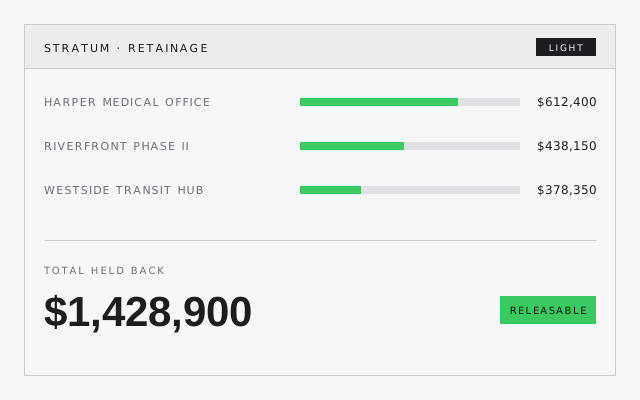
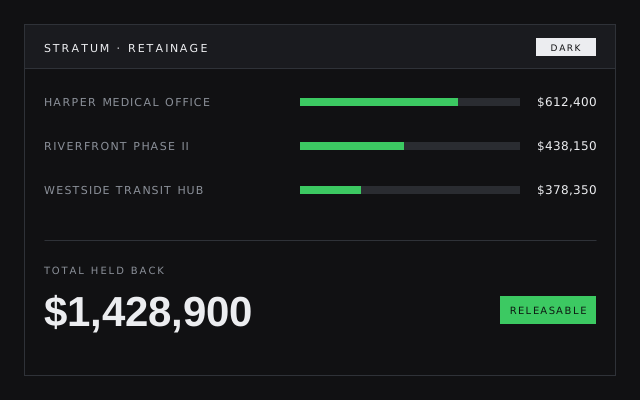
Stratum retainage panel showing held-back balances by project with a total held-back readoutStratum retainage panel showing held-back balances by project with a total held-back readout

Most contractors carry six or seven figures of retainage and track it in a spreadsheet that nobody trusts. Stratum 2.4 makes it a real balance — sourced from your billings, aged, and reconciled every time the books move.

What shipped

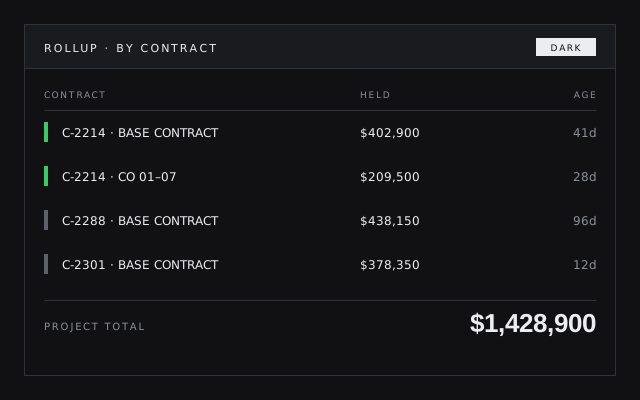
  • Per-contract retainage. Held-back amounts roll up from each pay application to the contract, then to the project, then to the portfolio. Base contract and change orders are tracked separately, because they are usually released separately.
  • Aging on every balance. Each held-back dollar carries the number of days since the billing that created it, so a 96-day balance stops hiding behind a healthy total.
  • Releasable flagging. When substantial completion or a contractual release milestone lands, Stratum marks the balance releasable and surfaces it in the 13-week cash view instead of leaving it parked in receivables.
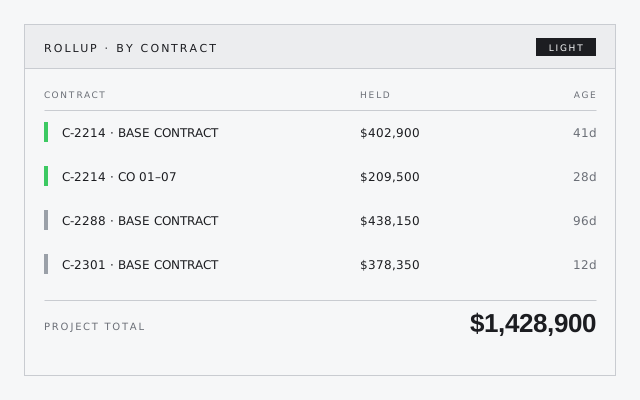
Retainage rollup listing base contract and change-order balances with age in daysRetainage rollup listing base contract and change-order balances with age in days
Retainage now rolls up per project and per contract.

Notes

Historical billings are backfilled on first sync, so the balances are populated the day you upgrade. Retainage receivable stays out of the standard AR aging report to avoid double-counting; it has its own line.
v1.9.0improvement

Draw packages assemble from field data in one pass

Quantities, photos, and sign-offs captured in Relay now compose a draw package automatically, so the pay application leaves the jobsite already supported.

Permalink

Draw requests fail on documentation, not on math. Relay 1.9 keeps the evidence attached to the quantity from the moment a foreman records it, so assembling the package is a review step rather than a scavenger hunt.

What shipped

  • One-pass assembly. Approved field quantities, their photos, and the crew sign-off travel together into the draw package. No re-keying, no chasing a phone camera roll on the last day of the month.
  • Lender-shaped output. The package exports in the format your lender's route already expects, so it moves through Interchange without a manual repack.
  • Blocking issues up front. Missing lien waivers, unsigned inspections, and quantities that exceed the schedule of values are flagged before submission instead of coming back as a rejection two weeks later.
Draw requests assemble from field data in one pass.

Notes

Existing draws in flight are untouched. The new assembly applies to any draw opened after the upgrade, and the old manual builder stays available from the draw menu through the end of the year.

v3.1.2fix

Schedule-of-values imports no longer drop change orders

A column-mapping bug dropped change-order lines from imported schedules of values when the source file used merged headers. Fixed, with affected routes re-synced.

Permalink

A schedule of values exported from certain project-management systems uses a merged header row above the change-order block. Our column mapper read that row as data, then skipped every line beneath it. The base contract imported correctly, so the totals looked plausible and the omission was easy to miss.

What changed

  • Merged headers are detected and skipped, and the change-order block is mapped to the same columns as the base contract.
  • Line-count validation on import. If the number of lines written does not match the number of lines read, the import fails loudly instead of completing with a short schedule.
  • Affected routes were re-synced. Any lender or program-manager route that received a truncated schedule since 3.1.0 has been refreshed with the corrected version, and the audit log records the correction.

Who was affected

Workspaces importing a schedule of values from a file with a merged change-order header between 3 January and 24 February 2026. We contacted the twelve affected workspaces directly before this note was published. No other route data was involved.

2025

security

SAML SSO, SCIM provisioning, and a 24-month audit trail

Workspaces can now enforce SAML single sign-on, provision and deprovision users through SCIM, and export a complete 24-month audit trail.

Permalink
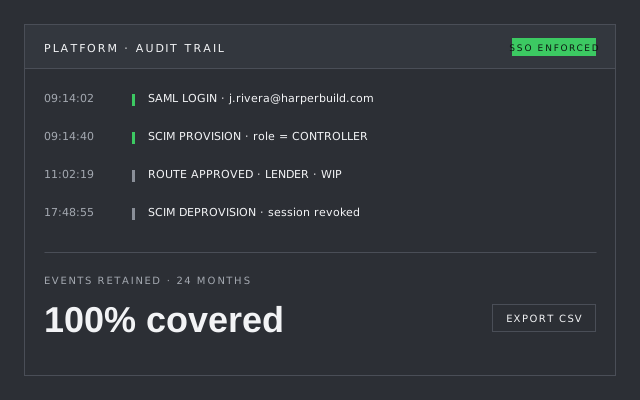
Platform audit trail listing SAML logins, SCIM provisioning events, and route approvals

Contractors working inside owner and lender programs are increasingly asked to prove who can reach financial data and how that access is revoked. This release answers that with configuration rather than a written policy.

What shipped

  • SAML 2.0 single sign-on. Works with Okta, Entra ID, and any SAML-compliant provider. Once enforced for a workspace, password sign-in is disabled for every member outside the break-glass owner account.
  • SCIM provisioning. Users and roles are created, updated, and deactivated from your identity provider. A deprovision revokes active sessions immediately rather than at next token expiry.
  • Audit trail with export. Sign-ins, role changes, route approvals, and every consent granted or revoked through Interchange are retained for 24 months and exportable as CSV.

Notes

SSO enforcement is available on Program and Enterprise workspaces. Turn it on under Settings → Security; we recommend running SCIM in provision-only mode for a full cycle before enabling deprovisioning.